


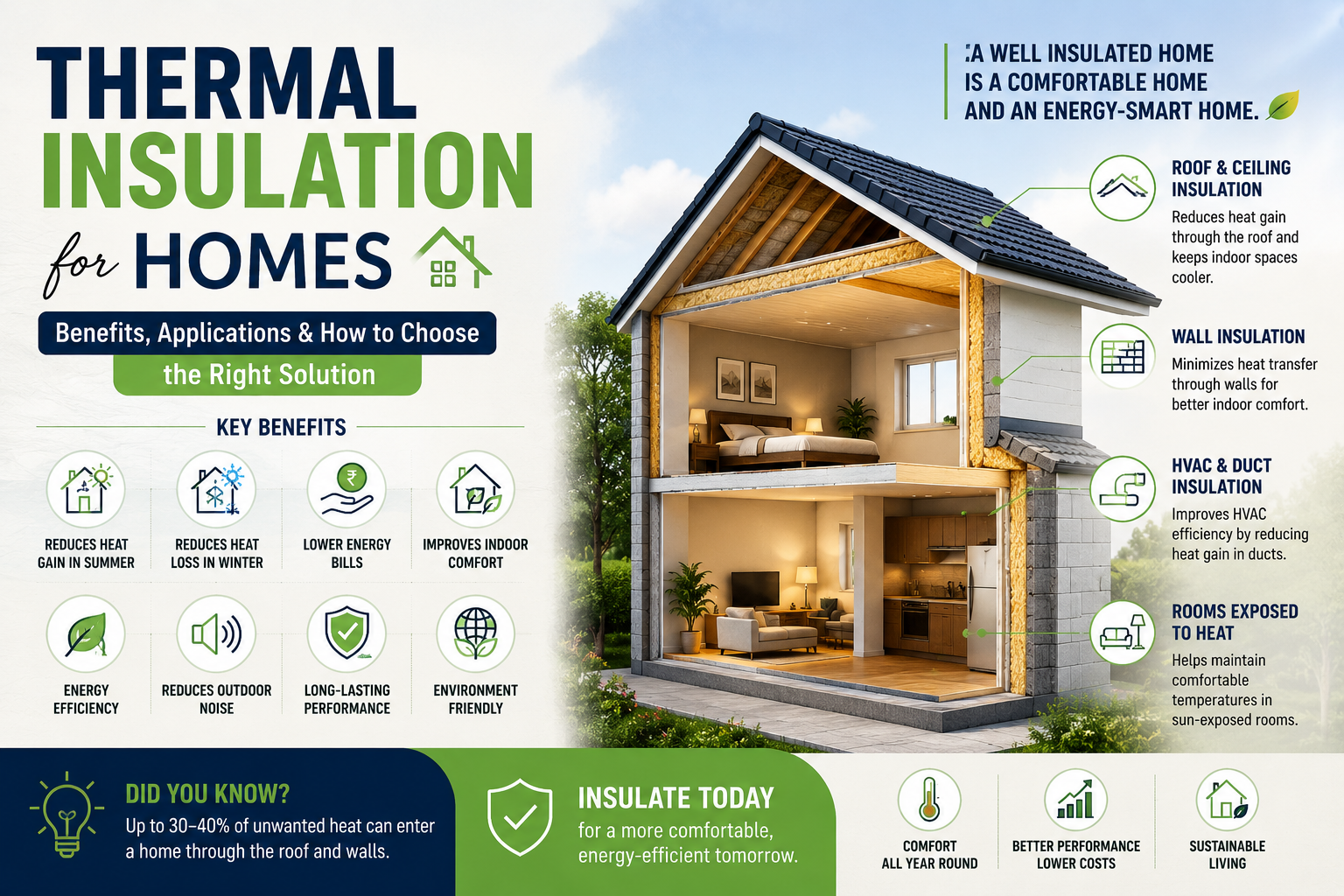
01 Sep Thermal Insulation for Homes: Benefits, Applications & How to Choose the Right Solution
A comfortable home is not only about good furniture, ventilation, or air conditioning. The way a house manages heat also plays an important role in indoor comfort and energy consumption.
During hot summers, heat can enter a home through the roof, walls, windows, and other parts of the building. In colder conditions, heat can escape through the same areas. Thermal insulation for homes helps reduce this unwanted heat transfer and creates a more comfortable indoor environment.
With increasing energy costs and greater awareness of energy-efficient construction, residential insulation is becoming an important consideration for homeowners, architects, and builders.
In this guide, we will explore the benefits of thermal insulation for homes, common applications, and the factors to consider when choosing the right insulation solution.
What Is Thermal Insulation?
Thermal insulation is a material or system designed to reduce the transfer of heat between two areas.
In a residential building, insulation can help reduce the movement of heat between the outside environment and indoor spaces.
For example, during summer:
Hot outdoor air → Roof/Wall → Insulation → Indoor space
A properly designed insulation system can slow down this heat transfer, helping the indoor environment remain more comfortable.
Similarly, during colder weather, insulation can help reduce the loss of indoor heat to the outside.
Why Is Thermal Insulation Important for Homes?
Homes are exposed to changing outdoor temperatures throughout the year. Without adequate insulation, the indoor temperature can be significantly affected by external weather conditions.
Thermal insulation can help:
- Reduce unwanted heat transfer
- Improve indoor thermal comfort
- Reduce heat entering the home during summer
- Reduce heat loss during colder weather
- Improve the efficiency of air-conditioning and heating systems
- Reduce energy consumption
- Create more consistent indoor temperatures
- Improve the overall energy efficiency of a building
The actual benefits depend on the building design, climate, insulation material, installation quality, and other factors.
1. Roof and Ceiling Insulation
The roof is one of the most important areas to consider when insulating a home.
In regions with hot summers, the roof can receive intense solar radiation throughout the day. This can cause the roof surface to become extremely hot and transfer heat into the rooms below.
Roof and ceiling insulation can help reduce this heat transfer.
It can be particularly useful for:
- Top-floor rooms
- Independent houses
- Villas
- Buildings with exposed roofs
- Homes with rooms directly below the roof
A properly designed roof insulation system can help make upper floors more comfortable during hot weather.
2. Wall Insulation
Walls are another major pathway for heat transfer.
External walls can absorb heat from sunlight and the surrounding environment. Some of this heat can then transfer into the interior of the home.
Wall insulation can reduce this transfer and help maintain a more stable indoor temperature.
Depending on the building design, insulation can be incorporated into external walls, internal wall systems, cavity walls, or other suitable construction assemblies.
The right approach depends on factors such as the building structure, available space, climate, and construction stage.
3. Insulation for HVAC Systems and Ducts
Air-conditioning systems are widely used in modern homes, particularly in warmer regions.
However, the efficiency of an HVAC system can also be affected by the condition of its ductwork.
When cooled air passes through ducts located in hot areas, heat can enter the duct from the surrounding environment. This can reduce the effectiveness of the cooling system.
Suitable duct insulation can help reduce unwanted heat transfer and support more efficient temperature control.
For residential buildings with centralized air-conditioning systems, duct insulation should be considered as part of the overall HVAC design.
4. Insulation for Rooms Exposed to Excessive Heat
Not every room in a house experiences the same thermal conditions.
Rooms facing direct sunlight for long periods or located beneath exposed roofs may become significantly warmer than other parts of the home.
Insulation can be particularly useful in:
- Top-floor bedrooms
- Living rooms with exposed external walls
- Rooms below terraces
- Home offices
- Rooms facing strong afternoon sunlight
Targeted insulation improvements can help address specific areas where excessive heat transfer is occurring.
5. Acoustic Benefits
Although thermal insulation is primarily used to control heat transfer, some insulation materials can also contribute to acoustic comfort.
In residential buildings, controlling unwanted noise can be important, particularly in:
- Apartments
- Bedrooms
- Home offices
- Homes near busy roads
- Shared-wall residences
Depending on the product and construction system, insulation can help reduce the transmission of airborne sound through walls, ceilings, and other building elements.
Therefore, homeowners can consider both thermal and acoustic requirements when selecting an insulation solution.
6. Fire Safety Considerations
Fire safety is an important consideration when selecting construction materials for a home.
The fire behaviour of insulation should be evaluated along with the complete building assembly.
For residential applications where fire safety is a priority, homeowners, architects, and builders should consider insulation materials with appropriate fire-performance characteristics for the intended application.
The correct selection should always be based on applicable building codes, project specifications, and manufacturer recommendations.
How Does Home Insulation Help Improve Energy Efficiency?
One of the main reasons homeowners consider insulation is to reduce the amount of energy required to maintain comfortable indoor temperatures.
Consider a home during summer.
If a large amount of heat continuously enters the building, the air conditioner needs to operate for longer periods to maintain the desired temperature.
With an appropriately designed insulation system, heat transfer through insulated building elements can be reduced.
This can help reduce the cooling load of the building.
The same principle applies during colder conditions. If indoor heat is escaping rapidly, heating systems need to work harder to maintain comfortable temperatures.
Therefore, insulation should be considered as part of a home’s overall energy-efficiency strategy rather than as a standalone product.
How to Choose the Right Insulation for a Home?
There is no single insulation solution that is suitable for every residential building.
Several factors should be considered before making a selection.
1. Location and Climate
The local climate plays an important role.
Homes in hot regions may have a greater need to control heat entering through roofs and external walls, while buildings in colder climates may place greater emphasis on preventing heat loss.
India has significant variations in climate, so insulation requirements can differ from one region to another.
2. Area Being Insulated
The insulation requirements for a roof may differ from those for a wall, ceiling, duct, or other building component.
Before selecting a product, identify exactly where the insulation will be installed.
3. Thermal Performance
Thermal performance is one of the most important selection criteria.
Engineers and builders should consider properties such as thermal conductivity and the expected operating conditions of the insulation system.
The objective is to select an appropriate insulation system based on the required thermal performance rather than simply choosing the thickest available material.
4. Required Thickness
Insulation thickness affects thermal performance, space requirements, installation, and overall project cost.
The appropriate thickness should be determined according to the building design, climate, desired thermal performance, and applicable requirements.
5. Fire Performance
Fire safety should always be considered when selecting insulation for residential construction.
Check the fire-performance characteristics of the product and ensure that the selected system is appropriate for the intended application.
6. Moisture and Environmental Exposure
Insulation can be exposed to different environmental conditions depending on where it is installed.
Roof insulation, for example, may face greater exposure to moisture and weather conditions than insulation installed within an internal wall assembly.
The complete system should therefore be designed to protect the insulation from conditions that could affect its performance.
7. Installation Quality
Good insulation material alone does not guarantee good results.
Gaps, poorly sealed joints, compression, incorrect fastening, or improper installation can reduce the effectiveness of an insulation system.
Installation should follow the manufacturer’s recommendations and the requirements of the building design.
New Construction vs Existing Homes
Insulation can be considered both during new construction and when improving an existing home.
During New Construction
Planning insulation during the design and construction stage makes it easier to integrate insulation into:
- Roof systems
- Walls
- Ceilings
- HVAC systems
- Other building elements
It can also allow architects and engineers to consider insulation as part of the overall energy-efficiency strategy.
For Existing Homes
Existing homes can also benefit from insulation upgrades.
Homeowners can identify areas where excessive heat transfer is occurring and consider improvements such as:
- Roof insulation
- Ceiling insulation
- Wall insulation
- HVAC duct insulation
- Improved sealing around building elements
A professional assessment can help identify the areas where insulation improvements may provide the greatest benefit.
Common Mistakes to Avoid
Choosing Insulation Based Only on Price
The cheapest material may not always provide the best long-term value.
Thermal performance, durability, fire performance, installation requirements, and expected service life should also be considered.
Ignoring the Roof
In hot climates, the roof can be a major source of heat gain. Focusing only on walls while ignoring the roof may limit the overall effectiveness of a residential insulation strategy.
Using the Wrong Thickness
More insulation is not automatically better if the application does not require it. The appropriate thickness should be determined based on thermal calculations and project requirements.
Poor Installation
Even a high-quality insulation product can perform poorly when installed incorrectly.
Gaps, compression, damaged sections, and poorly treated joints can create pathways for heat transfer.
Ignoring Ventilation and Other Building Factors
Insulation is only one part of a home’s overall thermal performance.
Ventilation, windows, shading, building orientation, air leakage, roofing materials, and HVAC efficiency can also influence indoor comfort and energy consumption.
A Complete Approach to Residential Thermal Comfort
The best results are usually achieved when insulation is considered together with other elements of building design.
A well-designed home may combine:
Thermal insulation + Efficient windows + Proper ventilation + Shading + Efficient HVAC + Good building design
This integrated approach can help reduce unwanted heat transfer and improve indoor comfort.
Final Thoughts
Thermal insulation can play an important role in creating comfortable and energy-efficient homes. By reducing unwanted heat transfer through roofs, walls, ceilings, and HVAC systems, a properly designed insulation system can help maintain more stable indoor temperatures and reduce the workload on cooling or heating systems.
However, choosing the right insulation requires more than selecting a product based on thickness or price. Climate, building design, application, thermal performance, fire safety, moisture exposure, and installation quality should all be considered.
For homeowners, architects, and builders planning a new residential project or upgrading an existing property, evaluating insulation early in the design process can help create a more comfortable and efficient home.
Looking for thermal insulation solutions for residential applications? Hi-Tec Rock Fibre offers insulation solutions designed for various building and thermal insulation requirements. Contact the Hi-Tec team to discuss the appropriate solution for your project.
No Comments