

14 Apr Stonewool vs. Ceramic Fibre: Choosing the Right Insulation for High-Temperature Applications
For industrial engineers and procurement specialists, selecting the correct insulation is a high-stakes decision. The choice between stonewool vs ceramic fibre isn’t just about price—it’s about matching material properties to the thermal, mechanical, and chemical demands of a specific environment.
At Hi-Tec Rock Fibre, we understand that navigating the world of high temperature insulation materials can be complex. While both materials are designed to resist heat, they operate in different leagues when it comes to peak temperature, weight, and structural application. This guide provides a deep-dive comparison to help you make an informed engineering choice for your facility.
What is Stonewool Insulation?
Stonewool, also known as mineral wool or rock wool, is a versatile, high-density insulation derived from volcanic rock (basalt) and industrial slag. The manufacturing process involves melting these raw materials at temperatures exceeding 1500°C and spinning the molten liquid into fine, intertwined fibres.
Stonewool is the “all-rounder” of industrial insulation. It is naturally non-combustible, provides excellent acoustic dampening, and maintains its R-value (thermal resistance) even under significant mechanical pressure. In the Indian industrial landscape, stone wool insulation comparison often focuses on its cost-effectiveness for medium-to-high heat applications, such as steam pipes, boilers, and storage tanks.
What is Ceramic Fibre Insulation?
Ceramic fibre insulation (Refractory Ceramic Fibre or RCF) is an engineered aluminosilicate material designed for the extreme upper echelons of the temperature scale. It is produced by melting high-purity alumina and silica, which are then “blown” or “spun” into a white, wool-like mass.
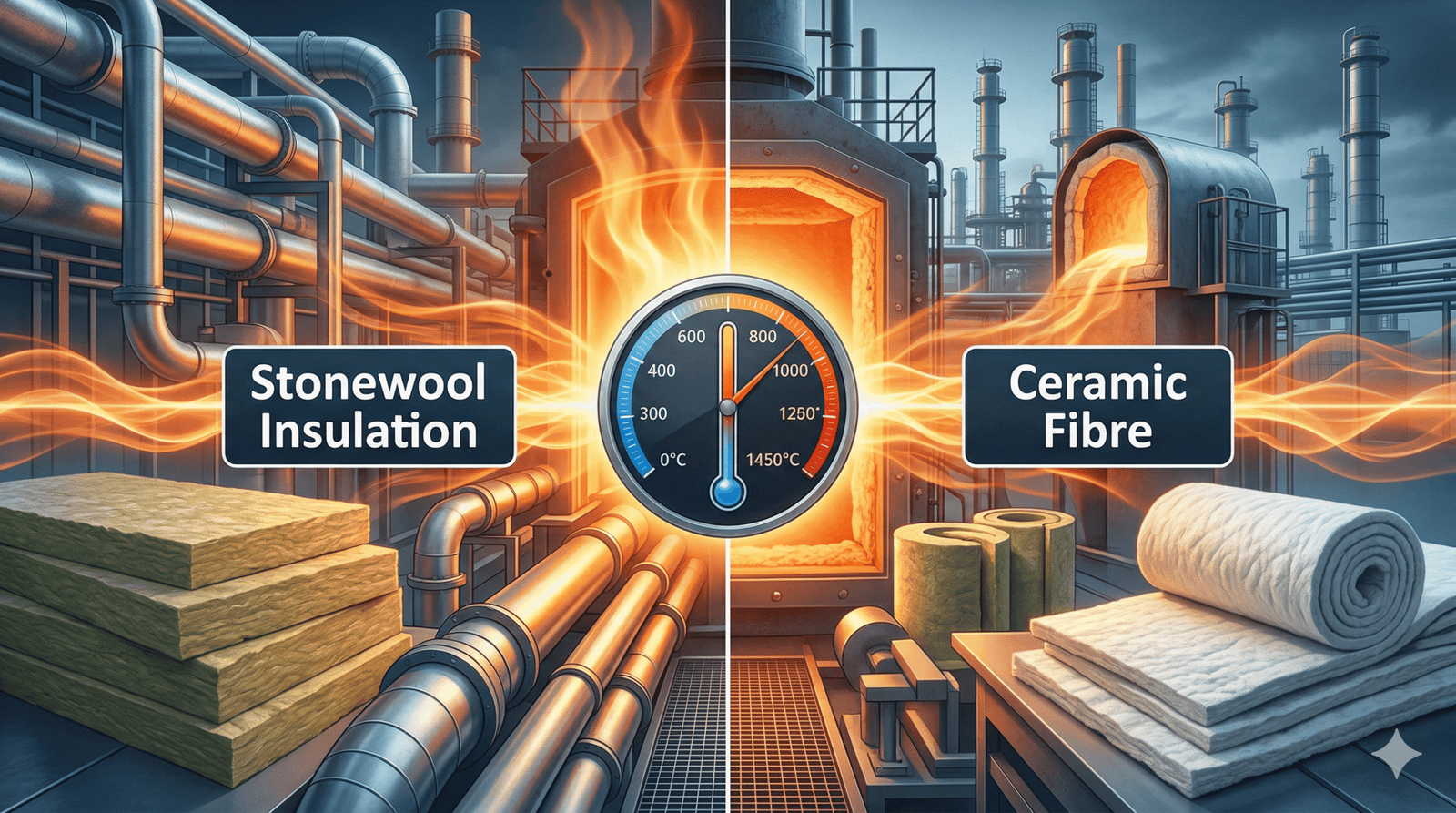
Unlike stonewool, ceramic fibre is incredibly lightweight and has a very low thermal mass. This means it doesn’t “store” much heat, allowing industrial furnaces to reach operating temperatures faster and cool down rapidly for maintenance. For applications requiring heat resistance up to 1450°C, ceramic fibre is the undisputed industry leader.
Stonewool vs. Ceramic Fibre: The Head-to-Head Comparison
To understand which material suits your project, we must look at the technical specifications side-by-side.
| Feature | Stonewool Insulation | Ceramic Fibre Insulation |
| Primary Composition | Basalt Rock & Slag | Alumina & Silica |
| Max Service Temp | Typically up to 750°C – 850°C | Up to 1260°C – 1450°C |
| Density | High (40−200 kg/m3) | Low (64−160 kg/m3) |
| Thermal Mass | High (Retains heat longer) | Low (Heats/Cools quickly) |
| Acoustic Absorption | Excellent | Moderate |
| Flexibility | Rigid boards or semi-flexible blankets | Highly flexible blankets/papers/modules |
| Common Uses | Pipes, Boilers, Fire-proofing | Kiln linings, Forges, Furnace doors |
Performance in Industrial Environments
1. Thermal Stability and Shrinkage
At temperatures below 700°C, both materials perform excellently. However, as you approach the 1000°C+mark, stonewool begins to lose its structural integrity and may begin to melt. Ceramic fibre maintains its dimensional stability even at 1450°C. It resists “linear shrinkage,” ensuring that no gaps form in the insulation layer over time.
2. Resistance to Chemicals and Moisture
In refineries and petrochemical plants, insulation is often exposed to corrosive gases and humidity.
- Stonewool is naturally hydrophobic (water-repellent) and chemically inert. It is particularly effective at preventing Corrosion Under Insulation (CUI) because it doesn’t “wick” moisture toward the pipe.
- Ceramic Fibre is also chemically stable but is more porous. If it becomes saturated with water, its insulating properties drop significantly until it is completely dried out.
3. Mechanical Strength and Vibration
In facilities with high-vibration machinery (like large power plant turbines), stonewool insulation is often preferred for exterior cladding because of its higher density and compressive strength. It can withstand the physical rigors of industrial foot traffic and mechanical stress better than the softer, more delicate ceramic fibre.
Why Industries Combine Both Materials
The most sophisticated engineering designs don’t choose just one; they use a “Hybrid Insulation Strategy.”
By combining high temperature insulation materials, plants can optimize both cost and performance:
- The Hot Face: Ceramic fibre is used as the primary lining (the “Hot Face”) inside the furnace because it can handle direct contact with flames and extreme heat up to 1450°C.
- The Backup Layer: Stonewool is used as a “backup” insulation behind the ceramic layer. This reduces the overall cost of the insulation system while providing a thick, dense barrier that prevents radiant heat from reaching the outer steel shell of the equipment.
Hi-Tec Rock Fibre: Solutions for the Full Spectrum
At Hi-Tec Rock Fibre, we don’t believe you should have to compromise. Our inventory is built on the philosophy that every degree matters. We provide a specialized range of both stonewool and ceramic fibre products designed to work in harmony.
Why source from Hi-Tec Rock Fibre?
- The 0°C to 1450°C Range: Whether you need a simple wrap for a chilled water line or a 1450-degree for a melting furnace, we have the stock ready to ship.
- Precision Engineering: We offer ceramic fibre in various forms—blankets, boards, paper, and modules—allowing for precise installation in complex geometries.
- Proven Expertise: Our products are used across India’s most demanding sectors, including steel forging, power generation, and chemical refining.
Final Verdict: Which One Do You Need?
- Choose Stonewool if: Your application is below 700°C, you need soundproofing, or you require a material that can withstand moisture and mechanical pressure. It is the most cost-effective solution for standard industrial pipes and boilers.
- Choose Ceramic Fibre if: You are dealing with temperatures between 800°C and 1450°C, you need a lightweight material for a kiln or furnace, or you require a lining that allows for rapid thermal cycling.
Conclusion
The debate of stonewool vs ceramic fibre isn’t about which material is “better,” but which one is better for your specific application. By understanding the temperature thresholds and physical properties of these high temperature insulation materials, you can significantly improve the safety and efficiency of your plant.
With Hi-Tec Rock Fibre as your partner, you gain access to the highest-quality sheets and blankets for any environment, from 0 to 1450 Deg Temperature.
Need a technical consultation for your project?
Visit the Hi-Tec Rock Fibre Website to view our full product specifications and datasheets.
Stay Updated:
Follow us on Instagram and Linkedin for side-by-side product tests, installation tips, and industrial success stories.
No Comments