


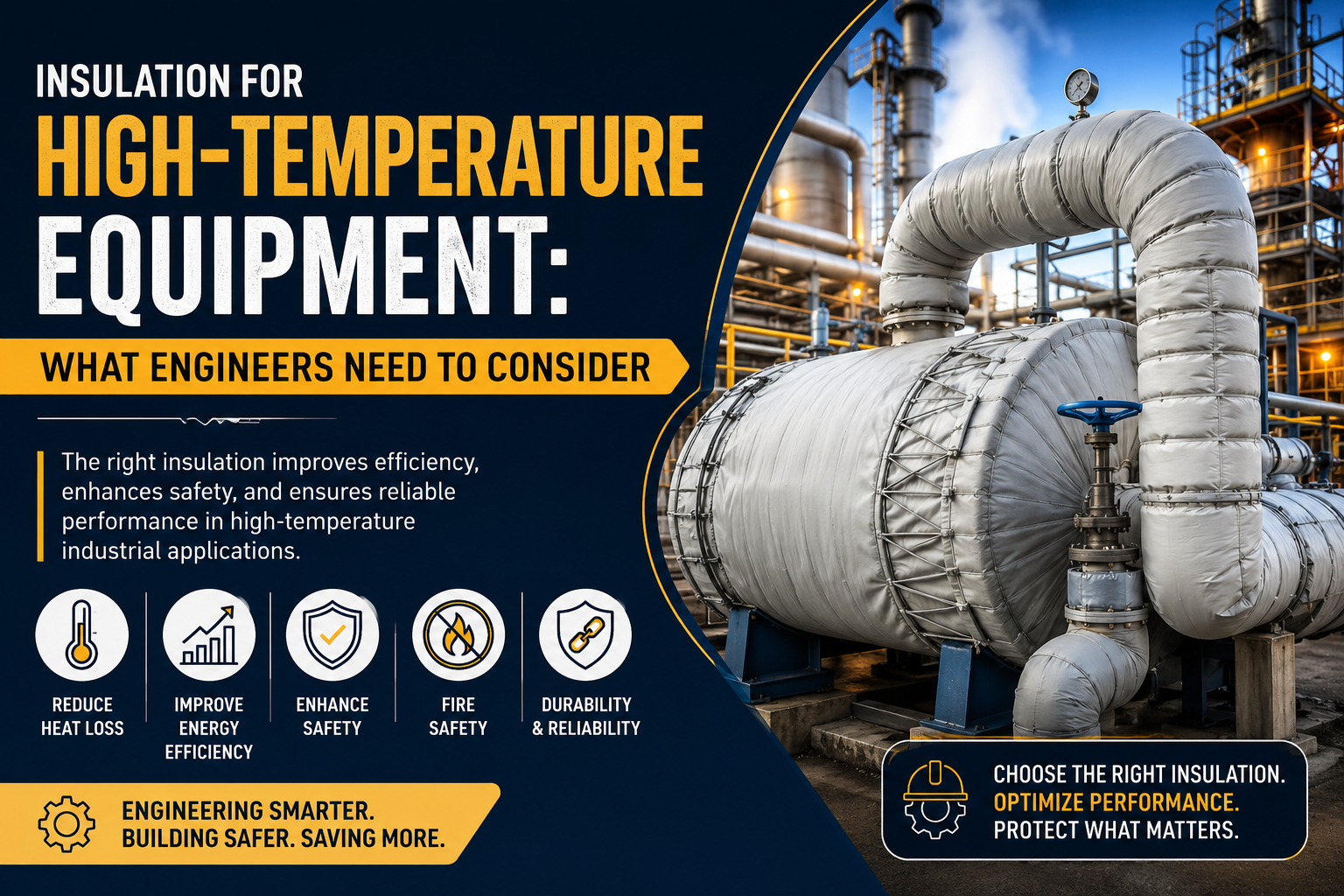
01 Sep Insulation for High-Temperature Equipment: What Engineers Need to Consider
High-temperature equipment is widely used across industries such as power generation, steel, cement, chemical processing, refineries, and manufacturing. Equipment operating at elevated temperatures can lose a significant amount of heat to the surrounding environment if it is not properly insulated.
For engineers, selecting insulation is not simply about choosing a material that can withstand high temperatures. The insulation system must also provide the required thermal performance, fire safety, mechanical stability, durability, and suitability for the specific application.
This guide explains the key factors engineers should consider when selecting insulation for high-temperature equipment.
Why Is Insulation Important for High-Temperature Equipment?
Industrial equipment operating at high temperatures continuously transfers heat to its surroundings. Without suitable insulation, this heat loss can affect process efficiency, increase energy consumption, and raise the temperature of surrounding areas.
Proper insulation can help:
- Reduce heat loss from equipment
- Improve energy efficiency
- Maintain the required operating temperature
- Reduce fuel and energy consumption
- Protect workers from hot surfaces
- Improve workplace safety
- Reduce thermal stress caused by temperature variations
- Support more consistent process conditions
- Protect nearby components from excessive heat
For large industrial facilities, even a relatively small reduction in heat loss can result in meaningful energy savings over time.
What Equipment Requires High-Temperature Insulation?
High-temperature insulation can be used in many industrial applications. Common examples include:
- Industrial furnaces
- Boilers
- Ovens
- Heat exchangers
- Storage tanks
- Hot pipelines
- Chimneys and stacks
- Ducting systems
- Process equipment
- Kilns
- Power plant equipment
- Chemical processing equipment
- Steel and metal processing equipment
The required insulation system depends on the equipment design, operating temperature, environment, and performance requirements.
1. Operating Temperature
The first factor engineers should evaluate is the equipment’s operating temperature.
Insulation materials have different temperature capabilities. The selected material should be able to continuously withstand the expected operating temperature without significant deterioration of its performance.
Engineers should consider:
- Normal operating temperature
- Maximum operating temperature
- Temperature fluctuations
- Start-up and shutdown temperatures
- Short-term temperature peaks
- Exposure duration
It is important not to select insulation based only on the average operating temperature. The maximum temperature and actual operating conditions should also be considered.
2. Thermal Conductivity
Thermal conductivity is one of the most important properties when evaluating insulation.
A material with lower thermal conductivity generally provides better resistance to heat transfer, helping reduce heat loss through the insulated surface.
However, thermal conductivity can change with temperature. Therefore, engineers should consider insulation performance at the actual operating temperature rather than relying only on a value measured at room temperature.
The objective should be to select an insulation system that provides the required thermal performance under real operating conditions.
3. Required Insulation Thickness
Choosing the correct insulation thickness is another important engineering consideration.
Insufficient thickness can result in excessive heat loss and high surface temperatures. On the other hand, using unnecessarily thick insulation can increase material costs, equipment dimensions, and installation requirements.
The appropriate thickness should be determined based on factors such as:
- Operating temperature
- Ambient temperature
- Required surface temperature
- Allowable heat loss
- Equipment geometry
- Insulation thermal conductivity
- Energy-saving objectives
- Applicable engineering standards
A proper thermal calculation can help engineers balance performance and project cost.
4. Fire Safety and Non-Combustibility
Fire safety is especially important in industrial environments where high temperatures, fuels, chemicals, and electrical equipment may be present.
The insulation material should be evaluated for its fire behaviour and suitability for the intended application.
For high-temperature industrial environments, non-combustible insulation can provide an additional level of fire protection and help reduce the contribution of insulation materials to fire propagation.
Engineers should review the relevant fire-performance requirements before selecting an insulation system.
5. Mechanical Strength
Thermal performance is not the only consideration.
Insulation installed around industrial equipment may experience mechanical loads, vibration, handling during installation, maintenance activity, and other physical stresses.
Therefore, engineers should consider the mechanical requirements of the application, including:
- Compression resistance
- Dimensional stability
- Resistance to handling damage
- Vibration exposure
- Support requirements
- Cladding or protective covering requirements
The insulation system should remain stable and functional throughout its expected service life.
6. Resistance to Temperature Changes
Industrial equipment does not always operate at a constant temperature.
Equipment may repeatedly go through:
Cold → Heating → Operating Temperature → Cooling → Cold
These temperature cycles can place stress on both the equipment and the insulation system.
Engineers should therefore consider how the selected insulation performs during repeated heating and cooling cycles.
A suitable insulation system should maintain its integrity and performance under the expected thermal conditions.
7. Moisture and Environmental Conditions
Moisture can significantly affect insulation performance in certain applications.
Engineers should evaluate whether the insulation will be exposed to:
- Rain
- Humidity
- Condensation
- Water leakage
- Process moisture
- Outdoor environments
- Chemical exposure
For outdoor installations, the insulation may require an appropriate weather-resistant outer covering or cladding.
The complete insulation system—not just the insulation material itself—should be considered during design.
8. Equipment Geometry
Industrial equipment rarely has a simple flat surface.
Engineers may need to insulate:
- Cylindrical tanks
- Pipes
- Valves
- Flanges
- Rectangular ducts
- Boilers
- Furnaces
- Irregular equipment surfaces
The insulation should be suitable for the shape and configuration of the equipment.
Special attention may also be required around joints, supports, openings, inspection points, and other areas where heat can escape.
9. Surface Temperature Requirements
Another important consideration is the temperature of the outer insulation surface.
High-temperature equipment can create a safety hazard if its external surface becomes excessively hot.
Proper insulation can help reduce surface temperatures and limit the risk of accidental contact burns.
For equipment located in areas where workers are present, engineers should consider the required safe surface temperature and design the insulation thickness accordingly.
10. Installation and Maintenance
Even a high-performance insulation material can fail to deliver the expected results if it is installed incorrectly.
Engineers should consider:
- Ease of installation
- Joint design
- Fastening methods
- Surface preparation
- Protective cladding
- Access to valves and inspection points
- Maintenance requirements
- Replacement procedures
Poorly fitted insulation can create gaps and thermal bridges, increasing heat loss.
The design should therefore account for both installation quality and future maintenance.
Common Applications of High-Temperature Insulation
High-temperature insulation systems are commonly used in several industrial sectors.
Power Plants
Insulation can be used around boilers, pipelines, turbines, ducts, tanks, and other high-temperature equipment to help reduce heat loss and improve plant efficiency.
Steel Industry
Steel manufacturing involves extremely high temperatures. Furnaces, ovens, ducts, and process equipment require insulation capable of operating reliably in demanding environments.
Chemical and Petrochemical Industries
Chemical processing facilities use heated vessels, pipelines, reactors, tanks, and other equipment where controlling heat transfer is important for process efficiency and safety.
Cement Industry
Kilns, ducts, pipelines, and other high-temperature equipment can benefit from suitable thermal insulation to reduce heat loss and improve operating efficiency.
Manufacturing Facilities
Industrial ovens, furnaces, dryers, and other heating equipment may require insulation to maintain process temperatures and improve energy efficiency.
Insulation Is a System, Not Just a Material
One of the most important points engineers should remember is that insulation performance depends on the complete system.
The overall design may include:
Equipment surface → Insulation → Fastening/support system → Protective cladding
Each component has a role.
For example, the insulation provides thermal resistance, while the external cladding may protect the insulation from moisture, mechanical damage, and environmental exposure.
A successful insulation design considers all these components together.
How Engineers Can Select the Right Insulation
Before finalizing an insulation system, engineers should evaluate the following:
- What is the normal operating temperature?
- What is the maximum operating temperature?
- How much heat loss is acceptable?
- What insulation thickness is required?
- What surface temperature is acceptable?
- Is fire safety a major requirement?
- Will the equipment be installed indoors or outdoors?
- Will the insulation be exposed to moisture?
- Is the equipment subject to vibration or mechanical stress?
- How frequently will the equipment require maintenance?
- What are the installation constraints?
- What standards and project specifications must be followed?
Answering these questions helps engineers develop an insulation system suited to the actual operating environment.
Final Thoughts
Selecting insulation for high-temperature equipment requires more than choosing a material based on its maximum temperature rating. Engineers need to evaluate thermal performance, operating conditions, insulation thickness, fire safety, mechanical requirements, environmental exposure, equipment geometry, installation methods, and long-term maintenance.
A properly designed insulation system can help industrial facilities reduce heat loss, improve energy efficiency, maintain process temperatures, and create safer working environments.
For high-temperature industrial applications, the right insulation solution should always be selected according to the equipment, operating conditions, and specific project requirements.
Looking for insulation solutions for high-temperature industrial equipment? Hi-Tec Rock Fibre provides insulation products designed for a range of industrial and commercial applications. Contact our team to discuss the requirements of your project.
No Comments