


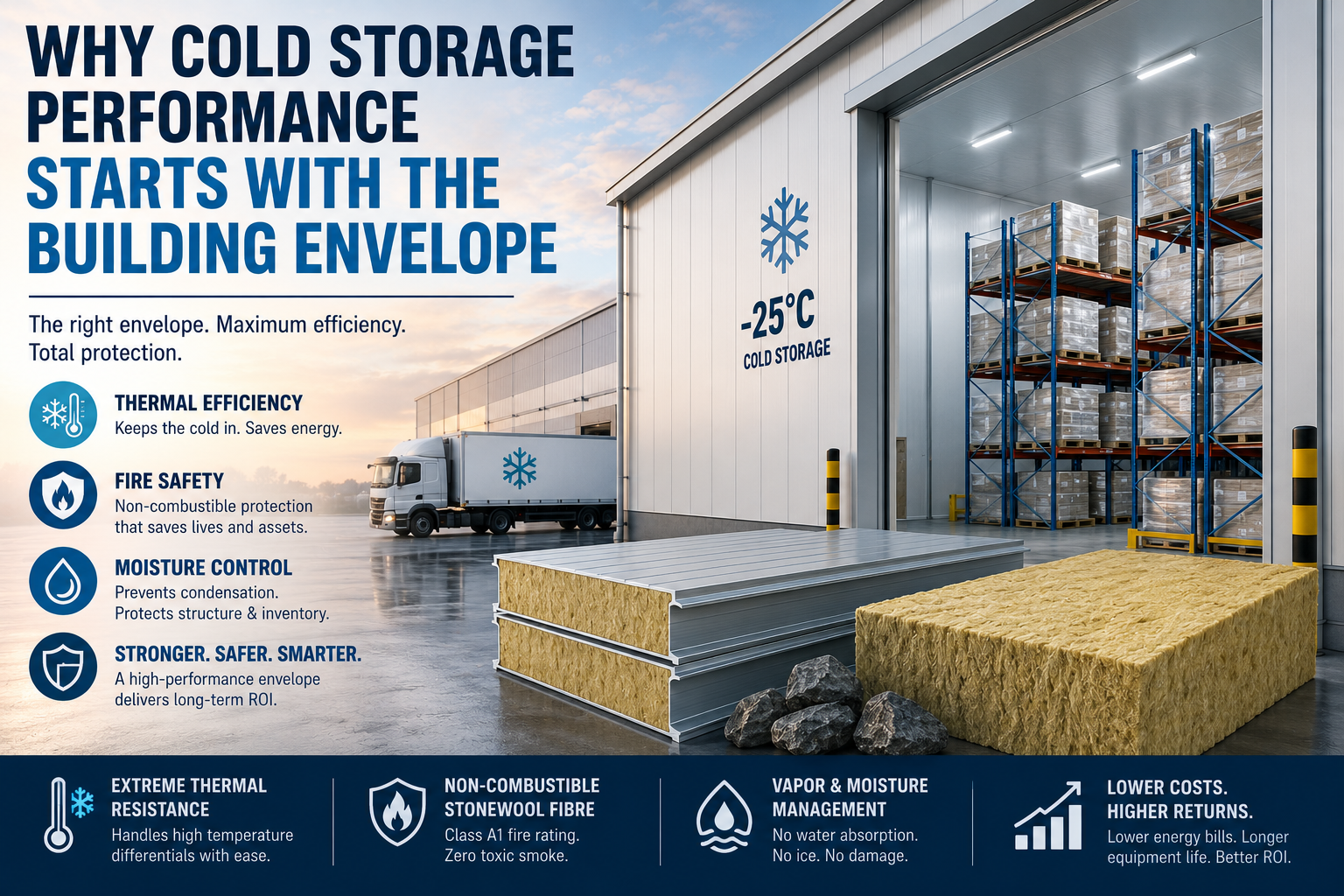
10 Aug Why Cold Storage Performance Starts With the Building Envelope
The global cold chain logistics sector is under more pressure than ever before. Driven by the rapid expansion of online grocery delivery, stringent regulations regarding pharmaceutical storage, and a complex global food supply chain, the demand for high-quality refrigerated warehousing has skyrocketed.
When facility managers and developers look to improve the performance of a cold storage facility, they often focus on upgrading to the latest high-efficiency compressors, advanced ammonia refrigeration systems, or automated retrieval robotics. However, none of these mechanical systems can operate at peak efficiency if the building itself is fundamentally flawed.
True operational performance does not begin in the mechanical room; it begins with the building envelope. The walls, roof, and floor slab that separate your sub-zero interior from the ambient exterior climate dictate your facility’s energy consumption, structural longevity, and overall safety. Here is a deep dive into why the building envelope is the single most critical component of cold storage, and how utilizing advanced core materials like stonewool fibre can safeguard your most valuable assets.
1. The Physics of Cold Storage: A Constant Battle Against Nature
To understand the importance of the building envelope, one must understand the extreme physics at play in a cold storage facility. Standard dry warehouses typically only need to manage a temperature difference of 10°C to 15°C between the inside and the outside.
Cold storage facilities, however, operate under extreme stress. A blast freezer or deep-freeze storage unit may need to maintain internal temperatures of -25°C (-13°F). If the facility is located in a warm climate where summer temperatures reach 35°C (95°F), the building envelope is forced to manage a massive temperature differential (delta) of 60°C.
Nature despises this imbalance. Thermodynamics dictates that heat will relentlessly try to force its way into the cold space. If the building envelope is weak, heat infiltrates the facility, forcing the refrigeration systems to run continuously to extract it. This constant battle leads to premature mechanical wear, massive energy spikes, and the risk of temperature excursions that can spoil millions of dollars worth of sensitive inventory. A high-performance envelope acts as an impenetrable fortress, holding the line against thermal transfer so your mechanical systems don’t have to.
2. The Core of the Envelope: Why Insulation Material Matters
The backbone of a cold storage building envelope is its insulation. In modern construction, this is almost exclusively achieved using Insulated Metal Panels (IMPs) or sandwich panels, which consist of a rigid insulation core bonded between two metal skins.
While the metal skins provide structural rigidity and act as a vapor barrier, the thermal performance relies entirely on the core material. Historically, many facilities relied on polyurethane (PUR) or polyisocyanurate (PIR) foams. However, modern engineering standards are increasingly shifting toward mineral-based solutions like stonewool fibre.
Stonewool fibre provides exceptional, long-lasting thermal resistance. Manufactured by spinning molten rock and minerals into dense layers of intertwined strands, it traps millions of microscopic air pockets. Because it is dimensionally stable, stonewool does not shrink, warp, or off-gas over time. This means the R-value (thermal resistance) you pay for on day one remains exactly the same on day ten thousand, preventing the slow degradation of thermal efficiency that plagues other materials.
3. The Counterintuitive Threat: Extreme Fire Risks in Sub-Zero Environments
It is a common misconception that cold, icy environments are safe from fire. In reality, cold storage facilities represent one of the most severe fire risks in the industrial sector.
The environment inside a cold storage warehouse is incredibly dry, as refrigeration continuously strips moisture from the air. The space is densely packed with highly combustible materials, including wooden pallets, cardboard packaging, and plastic wrapping. Furthermore, many facilities utilize ammonia-based refrigeration systems, which can be highly volatile if a leak occurs during a thermal event.
If a fire breaks out in a facility utilizing combustible foam insulation, the results are often catastrophic. The foam can act as an accelerant, rapidly spreading flames hidden within the wall cavities and releasing thick, toxic black smoke that makes firefighting nearly impossible.
This is where stonewool fibre drastically alters the risk profile of a cold storage building. Rockwool is inherently and entirely non-combustible. With a melting point exceeding 1,000°C (1,800°F), it holds a Class A1 fire rating. When utilized as the core of an insulated panel system, stonewool fibre acts as a physical firestop. It will not burn, it will not contribute to the fuel load, and it emits zero toxic smoke. Protecting your envelope with rockwool ensures that an isolated electrical short or forklift fire does not escalate into the total loss of the facility.
4. Managing Vapor Drive and Interstitial Condensation
Heat transfer is not the only physical force attacking a cold storage envelope; vapor drive is equally destructive. Because cold air holds less moisture than warm air, there is a constant, powerful pressure pushing water vapor from the warm, humid exterior into the dry, freezing interior.
If the building envelope is compromised and allows this water vapor to penetrate the wall cavity, it will eventually reach the dew point and condense into liquid water. Because the interior is below freezing, this water turns directly into ice within the walls (known as interstitial condensation). As ice expands, it physically tears the structural panels apart from the inside out, leading to massive structural failures and costly envelope replacements.
A properly designed envelope manages this through perfect airtightness and robust vapor barriers on the warm side of the wall. However, the choice of internal insulation is the ultimate fail-safe. Stonewool fibre is uniquely hydrophobic—it chemically repels liquid water. If minor moisture breaches do occur, stonewool will not soak up water like a sponge. It maintains its thermal properties and allows for vapor permeability, ensuring that trapped moisture doesn’t compromise the structural integrity of the entire cold storage wall system.
5. The Long-Term ROI of a High-Performance Envelope
Investing in a premium building envelope requires upfront capital, but in the context of cold storage, the Return on Investment (ROI) is rapid and continuous.
| Metric | Impact of a High-Performance Envelope |
| Energy Consumption | Reduces the operational load on refrigeration compressors, lowering electricity bills by up to 30%. |
| Mechanical Lifespan | Prevents refrigeration systems from short-cycling and running at maximum capacity, extending equipment life. |
| Insurance Premiums | Utilizing non-combustible stonewool fibre significantly lowers commercial property insurance rates. |
| Product Safety | Eliminates thermal bridging and cold spots, ensuring strict compliance with FDA/pharma temperature regulations. |
By building with materials that guarantee thermal stability and eliminate fire risks, developers protect both their immediate operational budgets and their long-term structural assets.
Secure Your Cold Chain with Hitec Rockfibre
In the high-stakes world of cold chain logistics, you cannot afford a weak link in your building envelope. The insulation you choose dictates the survival of your mechanical systems, the safety of your inventory, and the security of your workforce.
At Hitec Rockfibre, we provide the industrial sector with the highest quality stonewool fibre insulation solutions. Engineered for extreme thermal performance and unparalleled fire safety, our products are the trusted core for high-performance cold storage facilities.
Don’t compromise on your building’s first line of defense.
Visit hitecrockfibre.com today to learn how our advanced stonewool and rockwool products can optimize the envelope of your next cold storage project.
No Comments