


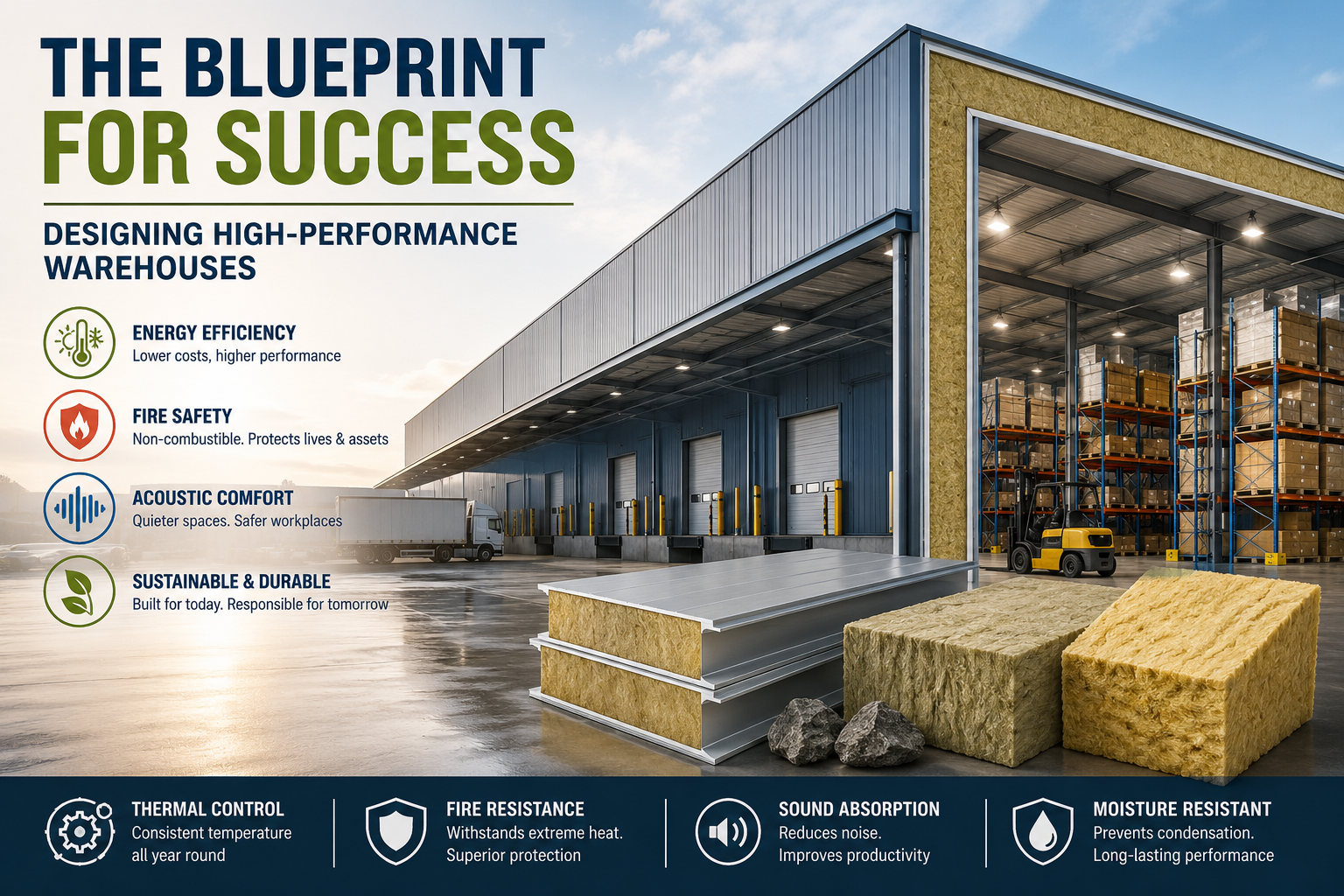
10 Aug The Blueprint for Success: Designing High-Performance Warehouses
The modern warehouse is no longer just a passive, massive storage box. Driven by the explosive growth of global e-commerce, increasingly strict cold-chain logistics requirements, and a worldwide push toward sustainable green building standards, today’s industrial spaces must be dynamic, energy-efficient, and impeccably safe.
Designing a high-performance warehouse means looking far beyond just square footage, racking layouts, and logistics software. The foundation of true, lasting performance lies in the building envelope itself—the walls, roofs, and foundations that separate the interior environment from the harsh outside world. From stringent thermal regulation to uncompromising fire safety, the architectural materials you choose dictate the long-term operational costs, safety, and lifespan of your facility.
Here is a comprehensive look at what you need to prioritize when designing a high-performance warehouse envelope, and why integrating premium core materials like stonewool fibre into your construction strategy is an absolute game-changer.
1. The Shift to High-Performance Building Envelopes
Historically, industrial warehouses were constructed with thin metal sheeting and minimal insulation. They were notoriously difficult to heat in the winter, sweltering in the summer, and prone to rapid degradation. Today, the focus has shifted to the “High-Performance Opaque Building Envelope”. This architectural approach optimizes structures for maximum energy efficiency, occupant comfort, and operational resilience.
A high-performance envelope relies on several key components:
- Continuous Insulation: Eliminating gaps where heat can escape or enter.
- Thermal Bridging Mitigation: Preventing structural elements (like steel studs) from acting as highways for heat transfer.
- Airtightness: Stopping unintended air leakage that forces HVAC systems into overdrive.
- Moisture Management: Utilizing vapor barriers and breathable materials to prevent interior condensation and mold.
Achieving all of these metrics simultaneously requires advanced materials. This is where modern prefabricated sandwich panels—specifically those utilizing a dense core of rockwool or stonewool fibre—have become the industry standard for industrial construction.
2. Uncompromising Energy Efficiency and Thermal Control
Warehouses feature expansive footprints, massive square footage, and high ceilings. Consequently, they require immense amounts of energy to heat and cool. For facilities storing temperature-sensitive goods—ranging from life-saving pharmaceuticals and sensitive electronics to perishable foods and beverages—even minor fluctuations in internal temperatures can lead to catastrophic inventory loss and regulatory compliance failures.
A high-performance warehouse mitigates these risks through superior thermal insulation. By lining roofs and utilizing wall panels cored with stonewool fibre, architects can create a highly stable, tightly controlled internal climate. Stonewool is engineered by spinning molten rock into millions of fine, intertwined strands. This complex matrix traps air within the material, drastically reducing thermal bridging and completely stalling heat transfer.
By keeping the freezing winter cold and the blistering summer heat outside where they belong, stonewool keeps your HVAC and refrigeration systems from working overtime. Over the lifespan of a massive industrial building, this yields monumental financial savings on energy bills while simultaneously shrinking the facility’s carbon footprint and aligning with global Net Zero initiatives.
3. Elite Fire Safety and Asset Protection
Industrial spaces house millions of dollars in inventory, highly automated robotic machinery, and, most importantly, human personnel. Given the density of goods and packaging materials (like cardboard and plastics) inside a logistics center, fire safety is the single most critical factor in warehouse design.
Standard industrial insulation materials, such as polyurethane (PU) or plastic-based foams, pose significant risks. Under sustained high heat, these materials can melt, drip, act as an accelerant, or release thick, highly toxic smoke.
Conversely, stonewool fibre is inherently non-combustible. Because it is literally manufactured from spun volcanic rock and minerals, it possesses an exceptionally high melting point. High-density rockwool can withstand temperatures exceeding 1,000°C (1,800°F) without melting, igniting, or releasing toxic gases.
When integrated into warehouse walls, roof panels, and internal partition structures, stonewool fibre acts as an uncompromising, physical fire barrier. In the event of an internal or external fire, a rockwool-insulated envelope prevents the rapid spread of flames. It protects the structural integrity of the building’s steel framing from heat-induced warping or collapse, providing crucial extra time for safe workforce evacuation and emergency response. For building owners, this Class A1 fire-resistance rating frequently results in easier building code compliance and significantly lower commercial insurance premiums.
4. Acoustic Comfort in High-Traffic Zones
Warehouses are inherently chaotic, loud environments. Between the continuous mechanical hum of heavy HVAC units, the piercing backup alarms of forklifts, the roaring of trucks at the loading docks, and the clattering of automated conveyor systems, the acoustic environment can quickly become hazardous. Prolonged exposure to high noise levels contributes directly to worker fatigue, dangerous miscommunications on the floor, and long-term hearing loss.
Designing a facility for optimal human performance means designing for acoustic comfort. The unique, multidirectional, and highly dense fibrous structure of stonewool fibre makes it an exceptional acoustic absorber.
When used in building panels, stonewool actively dampens internal sound reverberation (echo) and blocks noise transmission between different warehouse zones. For example, it is incredibly effective at separating deafeningly noisy loading bays or manufacturing floors from quiet, focused administrative offices. By absorbing low-frequency industrial vibrations and high-frequency mechanical noises, stonewool ensures a safer, more comfortable, and highly productive environment for your workforce.
5. Moisture Resistance and Long-Term Durability
A high-performance facility represents a massive capital investment. To ensure a return on that investment, the building must stand the test of time with minimal maintenance. A common silent killer of large industrial buildings is trapped moisture. Condensation building up within the hidden cavities of warehouse walls can lead to rapid structural corrosion, the degradation of thermal efficiency, and the growth of toxic mold that can ruin stored inventory.
Rockwool and stonewool fibres are uniquely suited to handle these challenges. They are highly water-repellent (hydrophobic) at the fiber level, meaning they will not absorb liquid water. However, they are also highly vapor-permeable. This vital characteristic allows the building envelope to “breathe.” If moisture vapor manages to penetrate the wall cavity, the stonewool allows it to pass through and evaporate outward, preventing dangerous condensation buildup.
Furthermore, because these fibres are manufactured from inorganic stone, they offer unparalleled long-term durability. Unlike organic insulations, stonewool will not rot, degrade, compress, or sustain mold and mildew growth over decades of use. It is also entirely unappealing to rodents and pests, ensuring your warehouse remains secure and uncontaminated.
6. Sustainable and “Green” Building Compliance
As the industrial real estate sector faces increasing pressure to meet Environmental, Social, and Governance (ESG) goals, the sustainability of building materials is under intense scrutiny. High-performance warehouses are increasingly designed to meet strict green building certifications, such as LEED or BREEAM.
Rockwool and stonewool fibres are champions of the circular economy. They are manufactured from abundant natural resources (like basalt rock) and often incorporate a high percentage of recycled industrial slag. The incredible energy savings they provide over a building’s lifespan far outweigh the energy required to manufacture them. Furthermore, at the end of a building’s life, stonewool can often be infinitely recycled back into new insulation products without a loss in quality, drastically reducing construction waste sent to landfills.
Build Your Next Facility with Hitec Rockfibre
Designing a high-performance warehouse is no longer a luxury; it is an operational necessity. To succeed, you require structural materials that work exactly as hard as your logistics and management teams. By prioritizing elite thermal efficiency, critical acoustic control, sustainable durability, and unmatched fire safety, you effectively future-proof your facility against rising energy costs, strict safety regulations, and a changing global climate.
At Hitec Rockfibre, we manufacture world-class stonewool fibre solutions engineered specifically for the most demanding commercial and industrial applications. Whether you are retrofitting an existing regional storage space or designing a state-of-the-art mega-distribution center from the ground up, our premium insulation products provide the ultimate structural shield for your building.
Ready to optimize your next high-performance warehouse project?
Visit hitecrockfibre.com today to explore our full range of industrial stonewool and rockwool insulation solutions, and let us help you build a safer, more efficient future.
No Comments